CompTIA's 2026 survey: 83% call upskilling imperative, yet only 34% run a formal programme. Why intent without a system fails, and how to build one.
Key takeaways
- CompTIA's Workforce and Learning Trends 2026 reports that 83% of HR and IT leaders agree improving employee skills is imperative, yet only 34% have a formal, organisation-wide reskilling or upskilling programme in place (CompTIA).
- The same research says 97% of companies acknowledge the importance of validating skills learned in training, and 94% use professional certifications as a factor when evaluating candidates.
- Training costs were named the largest challenge in developing learning programmes, followed by implementation, measurement and long-term management.
- Our reading: the bottleneck is rarely belief or even budget. It is the absence of a repeatable system: diagnose, train, practise, verify, repeat.
Last updated · Bodhih Insights team · reviewed by Siddharthan VGJ, Founder
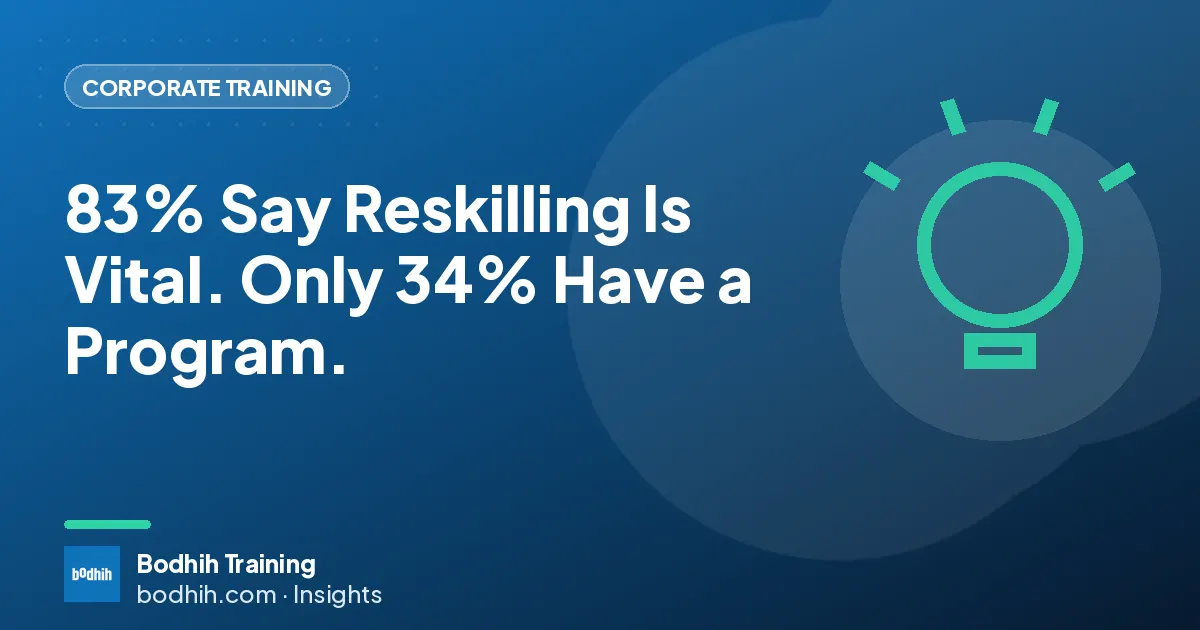
That is the quiet finding inside CompTIA's 2026 workforce research: a wide gap between believing in reskilling and running it. We call it the intent-to-system gap, and it may explain why so many "year of upskilling" announcements fade by March.
A note on sources: figures are as reported in CompTIA's press release and trade coverage of an April 2026 survey of 1,049 HR, L&D and IT professionals; we have not reviewed the full report. The survey is largely US-based. The India implications and the framework below are our interpretation, not findings of the study.
Why Intent Doesn't Become a Programme
When a priority is "imperative" but unstructured, it competes with everything else and loses. Four things usually stand between the intent and the system.
- No owner. Reskilling sits between HR, business heads and IT. Everyone supports it; nobody is accountable for it.
- No baseline. Without knowing who can do what today, you cannot design, fund or defend a programme.
- No proof. If completion is the only metric, leaders cannot tell whether capability changed, so budgets get questioned.
- No rhythm. One-off events replace a calendar. Skills decay between them.
CompTIA's own list of challenges (cost, implementation, measurement, long-term management) maps almost exactly onto these four.
The Quiet Signal: 97% Want Proof
The most interesting number may be the 97%. Nearly every organisation agrees that validating learning matters, yet only about a third have formal programmes to validate. In other words, the demand for proof is arriving before the infrastructure to produce it.
We saw the same pattern in India: ETS data showed that 89% are upskilling but few can prove it. Meanwhile, only 3% of training budgets go to the hands-on format that builds provable skill, and a perception gap hides how people really feel about the training they get.
Taken together: belief is high, structure is thin, and evidence is scarce.
From Intent to System: A Five-Part Loop
You don't need a giant transformation office. You need a small loop that runs every quarter.
- Name one owner and one number. Pick a single accountable leader and one outcome metric, such as "percentage of the sales team certified on the new process."
- Baseline with a skill gap analysis. Map the skills each role needs against what people can show today. A skill gap analysis turns "we need AI skills" into "these 40 analysts need these three skills."
- Prioritise the top three gaps. Resist the course catalogue. Three gaps, fully closed, beat thirty touched lightly.
- Train, then practise on real work. Pair the programme with manager coaching and live tasks so learning is applied within weeks. Coaching for managers keeps the practice going after the classroom.
- Verify and report. Use assessments before and after, and track progress by role and cohort on a learning platform. Share a one-page result with leadership every quarter.
Then repeat, using the evidence to choose the next three gaps.
What This Looks Like in India
Indian organisations face a particular version of the problem. Teams scale fast, many managers are first-timers, and business units often commission training independently, so a company can run dozens of good courses and still have no organisation-wide programme. A shared baseline and shared metrics are what convert scattered effort into a system.
A practical start: pick one function (say, customer operations), run the loop for 90 days, and publish the before-and-after numbers internally. A single credible result usually unlocks the next function's budget faster than any strategy deck.
How Bodhih Helps
- Skill Gap Analysis and Assessments to baseline and later verify capability.
- Leadership Skills Training and Coaching for Managers so line managers can own application.
- Train the Trainer to build internal facilitators who keep the programme running between external sessions.
- A Learning Management Platform to schedule, track and report progress.
Explore the full range on our corporate training solutions page, or book a meeting with a consultant to map your first 90-day loop.
The Bigger Idea
"Imperative" is a feeling. A programme is a calendar, an owner, a baseline and a result.
The organisations that pull ahead will not be the ones that agree most loudly that skills matter. They will be the ones that can show, quarter after quarter, which skills moved.
Frequently asked questions
What does CompTIA's 2026 research say about reskilling?
It reports that 83% of HR and IT leaders agree improving employee skills is imperative, but only 34% have formal, organisation-wide reskilling or upskilling programmes. It also reports that 97% of companies acknowledge the importance of validating skills learned in training.
What is the intent-to-system gap in corporate training?
It is the distance between agreeing that upskilling matters and having an owned, measured, repeating programme to deliver it. It is our term, not CompTIA's.
Why do many companies lack a formal upskilling programme?
Common causes are unclear ownership, no skills baseline, weak measurement and one-off events instead of a regular rhythm. CompTIA lists cost, implementation, measurement and long-term management as top challenges.
How do you start a formal reskilling programme?
Assign an owner and one metric, run a skill gap analysis, choose the top three gaps, combine training with practice on real work, then verify with assessments and report quarterly.
How can companies validate skills learned in training?
Use pre- and post-training assessments tied to specific job tasks, manager observation, and practical work samples, and track results by role and cohort.
Where do the facts in this article come from?
From CompTIA's press release on its Workforce and Learning Trends 2026 research and trade coverage of it. We have not reviewed the full report.