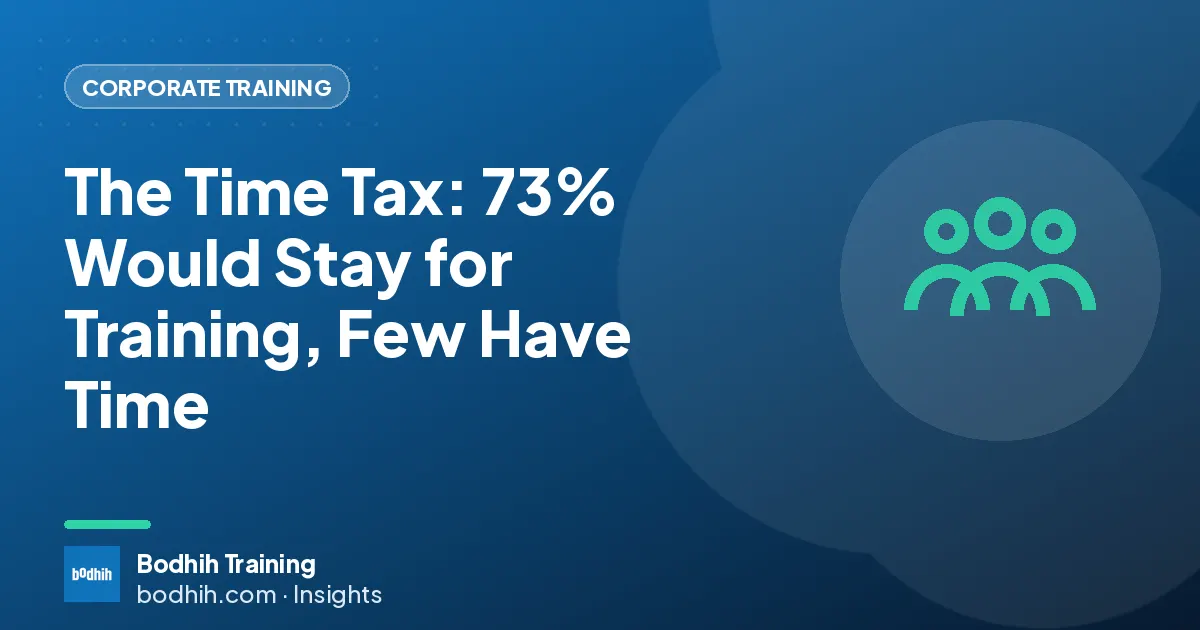
TalentLMS's 2026 report says 73% of employees would stay longer for better learning, yet over half lack time for it. Why time, not budget, is the real L&D.
Key takeaways
- The same research reports that 35% would actively look for another job if training is not provided, up from 24% a year earlier.
- More than half of employees say their workload leaves them no time for development, and 65% report higher performance expectations.
- The report also found a gap of nearly 20 percentage points between how HR managers and employees rate AI training support, echoing our look at the training perception gap.
- The survey is US-based. We have not seen an equivalent India-wide dataset, so treat the numbers as a signal to test in your own teams, not a verdict.
Last updated · Bodhih Insights team · reviewed by Siddharthan VGJ, Founder
Nobody refused to learn. The time simply never arrived. And according to new research, this is not one company's problem.
The Surprising Part: The Barrier Is Not Motivation
For years, the standard explanation for weak training results was that employees "are not interested". This data points the other way. Most people say learning would keep them in the company, and a growing share say they would leave without it.
So the demand is there. What is missing is capacity. Think of it as a time tax: every hour of learning has to be paid for out of a week that is already full. When workloads rise and expectations rise with them, learning is the first thing to be cancelled, because it is important but never urgent.
This changes the question L&D leaders should be asking. Not "How do we make training more attractive?" but "Where, exactly, does the learning hour come from?"
Why the Time Tax Hits Indian Teams Hard
The research is American, but the conditions that make time scarce are familiar here.
- Leaner teams. As we noted in The Great Flattening, fewer layers mean managers and individual contributors carry more.
- AI added tasks before it removed them. Our piece on the AI productivity paradox showed how faster tools often raise the volume of work rather than free up hours.
- Delivery pressure in services and tech. Client-facing roles rarely have slack, so a two-day classroom block can mean two days of missed commitments.
- Managers hold the key. Whether a person attends is often decided by their manager's mood that week, not by the calendar invitation.
Four Ways to Pay the Time Tax Smartly
You cannot create more hours, but you can spend them better.
- 1. Shrink the unit, not the ambition. A 20-minute practice task tied to this week's real work beats a full day that never happens. Break big topics into short, scheduled steps with a clear output each time.
- 2. Protect the time like a client meeting. Block it on calendars, and make managers accountable for releasing people. If learning hours are the first to be sacrificed, they were never really planned.
- 3. Learn on the work, not away from it. Ask participants to bring a live problem, such as a difficult conversation, a pitch or a team issue, and apply the skill during the programme. Learning that is already doing the job does not feel like a tax.
- 4. Space it out. Spread a programme over weeks, with practice between sessions, so each hour has time to turn into habit. This is also how the wrong format of training budgets can be corrected: less lecture, more hands-on repetition.
What Organisations Can Do About It
Design programmes as journeys, not events. Bodhih's learning journeys combine short live sessions, on-the-job practice and manager check-ins over several weeks, so development fits around a working schedule instead of competing with it.
Use live virtual formats where they fit. Live virtual training cuts travel and lets teams join in focused blocks, while still keeping the practice and feedback that make training work.
Start from the real gap. A short training needs analysis and skills assessments show where an hour of learning will matter most, so scarce time goes to the right people and topics.
Equip the people who control the time. Coaching for Managers helps leaders support development inside their teams' daily work, and Leadership Skills Training prepares them to protect learning time without hurting delivery.
Tailor the schedule to your business. A customised programme can be built around your peak seasons, shifts and client commitments, rather than around a trainer's availability.
The Bigger Idea
We often talk about a skills gap. This research hints at a quieter one: a time gap between what organisations want people to learn and what they allow people to do.
Closing the first without closing the second is like stocking a library and locking the doors. The Bengaluru L&D team did not have a content problem or a motivation problem. They had a calendar that treated learning as a favour. The companies that win the next few years will be the ones that treat it as work.
Frequently asked questions
What does the TalentLMS 2026 L&D report say about training and retention?
TalentLMS's 2026 Annual L&D Benchmark Report, which surveyed 1,000 US employees and 101 HR managers, found that 73% of employees say better learning and development opportunities would make them stay longer, and 35% would actively look for another job if training is not provided. These are stated intentions rather than measured behaviour.
Is lack of time really the biggest barrier to workplace learning?
In this research, more than half of employees said their workload leaves no time for development, and coverage describes workload as the most immediate barrier. Other barriers such as relevance and budget still matter, but time is the one most often cited.
Do these findings apply to India?
The survey sample is from the United States, so the exact percentages may differ in India. The underlying conditions, including lean teams, delivery pressure and rising workloads, are common in Indian organisations, so the pattern is worth checking in your own workforce.
How can companies make time for training without hurting productivity?
Break learning into short sessions linked to real work, block time on calendars, ask managers to release team members, use live virtual formats to cut travel, and spread programmes over weeks. Learning journeys with on-the-job practice are one practical way to do this.
How do we know if our training time is being used well?
Track completion and practice between sessions, not just attendance. Pair a pre-programme skills assessment with a post-programme check and manager feedback, and read the gap. Bodhih's assessments can support this.
Where do the statistics in this article come from?
From the TalentLMS 2026 L&D Benchmark Report and press coverage of it, published in December 2025. We could not open the full report from our research environment, so quotes are from secondary summaries. Please confirm figures at the TalentLMS source before formal use.