Simplilearn's 2026 survey: 85% use AI at work, 26% feel prepared, 71% feel on their own. Why usage isn't readiness, and how India's teams can close the gap.
Key takeaways
- Simplilearn's Professional Sentiment Survey 2026 (its second edition, released April 2026) is reported to show that 85% of professionals use AI at work regularly, but only 26% feel well-prepared to use it for long-term career growth (HRKatha, CXOToday).
- 71% say they feel left to navigate AI readiness on their own, even as companies roll out tools quickly.
- 76% say they are likely to invest in a certificate or training programme in 2026, a figure reported as consistent across the US, India, Europe and the UAE.
- Our reading: employees are not resisting AI or learning. They are under-supported. The demand is there; the structure is not.
Last updated · Bodhih Insights team · reviewed by Siddharthan VGJ, Founder
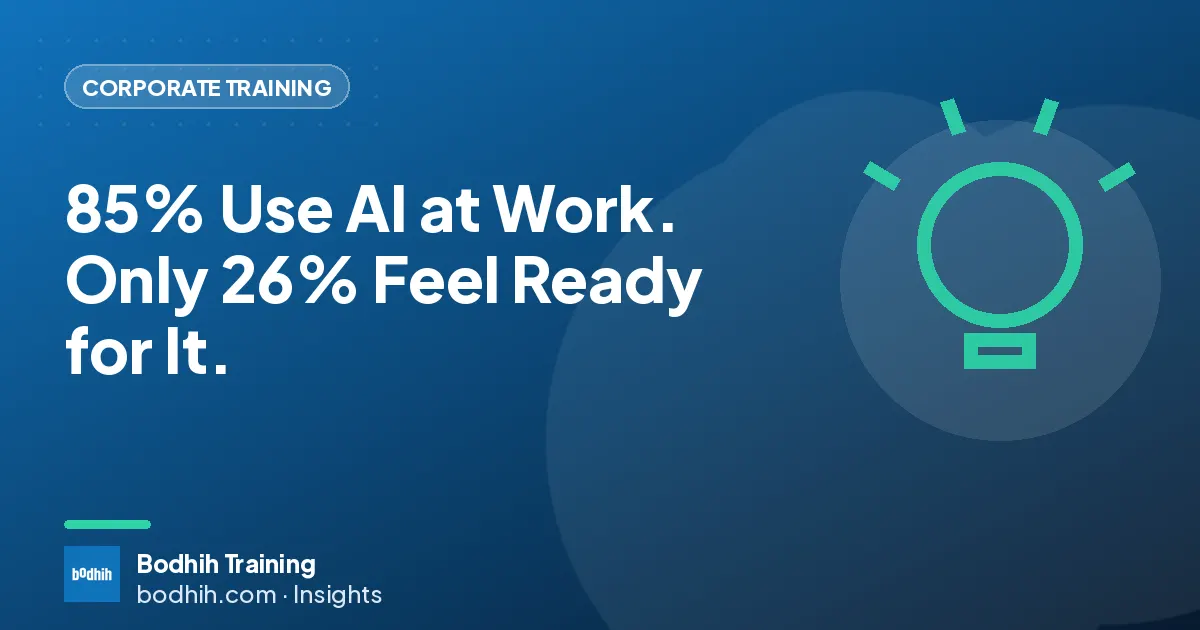
That distance is the use-readiness gap: people are using AI every day without feeling prepared by it. It is a different problem from access, and it needs a different fix.
A note on sources: figures are as reported in press coverage and Simplilearn's summary pages; we have not reviewed the full report. The survey draws on Simplilearn's own learner and prospect base, so it may not represent the wider workforce, and Simplilearn sells upskilling. Treat the numbers as directional. The India implications and framework below are our interpretation, not findings of the study.
Using a Tool Is Not the Same as Being Ready
Using AI is a low bar: open a tool, type a prompt, get an answer. Readiness is higher. It means knowing when the output is wrong, which tasks to hand over and which to keep, how to protect data, and how your own role is changing.
Most people pick up the first skill alone. Almost nobody picks up the second set alone. That is why a team can be 85% "adopted" and still feel 74% unprepared.
The Number That Matters Most: 71%
The 26% headline gets quoted. The 71% is the one to act on. It says the typical professional feels they are figuring out AI without guidance, rules or a path.
We have seen what happens next in India's workplaces: employees quietly use tools nobody approved, a two-speed workforce forms between the self-taught and everyone else, and managers expect AI use that nobody has actually defined.
Each is a symptom of the same cause: adoption was announced, but support was not designed.
Three Reasons Self-Directed Learning Isn't Enough
- It teaches tools, not judgement. Tutorials show features. They rarely teach how to check an AI answer against the real business context.
- It is uneven. Curious, time-rich people advance; busy frontline and first-time managers fall behind, widening internal gaps.
- It is invisible. Nobody can tell who has learned what, so leaders cannot assign work, fund programmes or measure return.
Closing the Use-Readiness Gap: A Four-Step Approach
- Define "ready" by role. Write two or three observable behaviours per role, for example "a sales manager can use AI to prepare account plans and can explain which parts they verified." A skill gap analysis makes this concrete.
- Set simple rules first. Clarify approved tools, what data never goes in, and when human review is mandatory. Clear rules reduce both risk and anxiety.
- Train on real tasks, with managers in the loop. Short, role-based practice on actual work beats generic courses. Coaching for managers helps leaders reinforce the habit weekly, not once a year.
- Check readiness, not attendance. Use assessments before and after to see who can do what, and track progress by role and cohort.
The Opportunity for India
If 76% of professionals say they intend to invest in training this year, the appetite is already there. For Indian employers, that is a rare advantage: you are not persuading people to learn, you are giving existing motivation somewhere to go.
Organisations that provide a structured path will likely keep and grow talent that would otherwise learn elsewhere, on their own time, and take that learning with them.
How Bodhih Helps
- Skill Gap Analysis and Assessments to define and verify role-level readiness.
- Leadership Skills Training and Coaching for Managers so line managers can guide AI adoption.
- Train the Trainer to build internal facilitators who sustain learning.
- A Learning Management Platform to deliver and track progress.
Explore our corporate training solutions or talk to a consultant about a role-based AI readiness plan.
The Bigger Idea
Adoption measures what people do. Readiness measures what people can do, and whether they feel supported doing it.
An organisation can score high on the first and low on the second for years without noticing. The surveys suggest many already are.
Frequently asked questions
What does Simplilearn's 2026 survey say about AI readiness?
As reported in press coverage, 85% of professionals use AI at work regularly, but only 26% feel well-prepared to leverage it for long-term career growth, and 71% feel left to navigate AI readiness on their own.
What is the use-readiness gap?
It is the gap between using AI tools regularly and being genuinely prepared for how AI changes your role and career. The term is ours, not Simplilearn's.
Why do employees feel unprepared even when they use AI daily?
Usage is easy to self-teach; judgement, data safety and role change are not. Without rules, role-based training and manager support, people feel they are improvising.
How can companies make employees AI-ready?
Define readiness by role, set clear rules on tools and data, train on real tasks with manager coaching, and verify capability with assessments.
How reliable is this data?
It comes from a survey of Simplilearn's own learner base, reported in press coverage and not reviewed in full by us. Use it as a directional signal rather than a population estimate.