Face-to-face interaction makes classroom training more effective because people are social beings, and in-person contact produces clearer communication, more fruitful interactions and richer learning. A Management Science study found videoconference participants pay more attention to a speaker's likability than to argument quality. Media richness theory also ranks face-to-face communication as the richest channel.
Last updated · Bodhih Insights team · reviewed by Siddharthan VGJ, Founder

This is what makes offline classes or classroom sessions more effective and impactful in producing results. People are social beings and they crave for face to face interaction when this happens, the outcome is better and clearer communication, more fruitful interactions and richer learning experience.
According to “Videoconferencing in the Field: A Heuristic Processing Model,” an article published in Management Science, professionals who participate in seminars via videoconferencing are more likely to pay attention to non-educational realities, such as the speaker’s likability rather than quality of presentation and arguments provided, as opposed to those who attend the activities in person.
Even the media richness theory goes on to emphasize how face to face interactions have clear advantages over other forms of communication. According to the theory different channels are arrayed along a media (information) richness continuum, with written media as relatively lean and face-to-face interactions as highly rich.
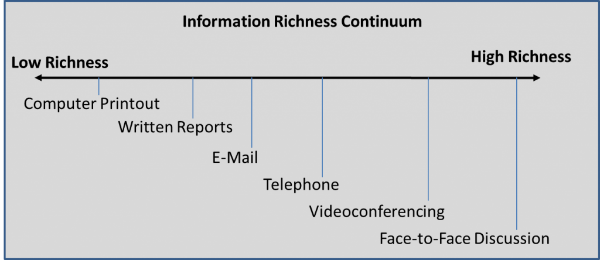
Research has found that disputes are more likely to escalate between two parties when they communicate electronically as compared to when they discuss issues either face-to-face or even telephone conversations.
Quick answers
What does media richness theory say about face-to-face communication?
Media richness theory arranges communication channels along a continuum of information richness. Written media sit at the lean end and face-to-face interaction at the rich end, which is why in-person conversations carry more cues and tend to produce clearer understanding than electronic channels.