A leadership competency assessment platform is software that maps, measures and benchmarks leadership competencies across an organisation using data rather than subjective opinion. Jobulary360 automates competency mapping, provides real-time analytics and objective competency feedback, and integrates with existing HR systems so large enterprises can standardise assessment and identify high-potential talent early.
Key takeaways
- Organisations often miss strategic targets due to a lack of internal talent alignment.
- Data-driven insights are essential for modernising professional development programmes.
- Jobulary360 enables businesses to map individual skills to core organisational objectives.
- Building a strong management pipeline requires consistent and objective evaluation.
- Strategic growth is achieved by prioritising the enhancement of human capital.
Last updated · Bodhih Insights team · reviewed by Siddharthan VGJ, Founder
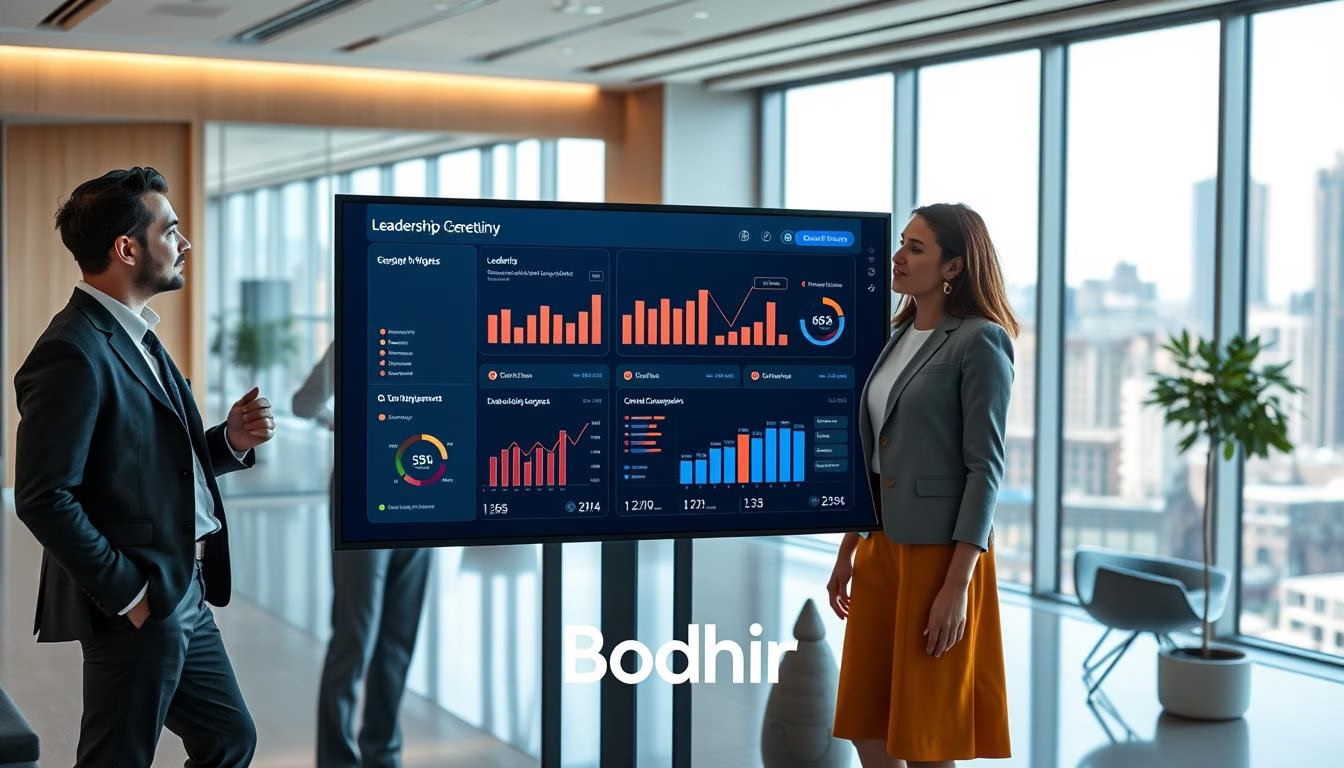
Effective growth requires more than just intuition; it demands a data-driven approach to talent management. Jobulary360 serves as a vital catalyst for this transformation. By utilising a sophisticated leadership competency assessment platform, decision-makers can identify hidden strengths and bridge skill gaps with precision.
This tool empowers firms to cultivate a robust pipeline of future managers. When capabilities are clearly mapped against business needs, the path to success becomes significantly clearer. Elevating your workforce is no longer a luxury but a necessity for long-term sustainability.
The Evolving Landscape of Leadership Development in India
As the Indian market integrates further into the global economy, the demand for sophisticated leadership capabilities has reached an all-time high. Organisations are no longer satisfied with generic training programmes; they require bespoke solutions that align with specific business objectives. This shift reflects a broader transition toward professional development that is both measurable and impactful.
Since 2008, firms such as Bodhih Training Solutions Private Limited have been at the forefront of this change. By focusing on the enhancement of corporate competencies, they have helped bridge the gap between traditional management styles and the requirements of a modern, globalised workforce. Their long-standing presence highlights the growing recognition that leadership is a skill set that must be cultivated with precision.
To remain competitive, businesses must now adopt more agile and data-informed training methodologies. The current landscape demands a departure from static learning models in favour of dynamic frameworks that evolve alongside the organisation. Key drivers of this transformation include:
- Strategic Alignment: Ensuring that leadership growth directly supports long-term corporate goals.
- Global Standards: Adopting international best practices to manage diverse, cross-functional teams effectively.
- Continuous Improvement: Moving away from one-off workshops toward a culture of ongoing professional development.
Ultimately, the ability to identify and nurture high-potential talent has become a critical differentiator for success in India. Companies that invest in structured, objective assessment processes are better positioned to navigate the complexities of the current business environment. By prioritising these capabilities, organisations ensure they are prepared for the challenges of tomorrow.
Defining the Modern Leadership Competency Assessment Platform
Modern organisations are shifting towards a dynamic leadership competency assessment platform to drive professional elevation. These systems represent a significant departure from the static, annual review cycles that once dominated the corporate landscape in India.
Instead of relying on subjective opinions, these platforms utilise data-driven frameworks to map individual and team capabilities. This transition allows businesses to gain a comprehensive view of their talent pool, ensuring that growth is both measurable and aligned with broader strategic objectives.
A sophisticated leadership competency assessment platform serves as a catalyst for continuous enlightenment within the workplace. By providing real-time feedback and clear development pathways, these tools empower managers to identify strengths and bridge skill gaps effectively.
Ultimately, the goal is to foster an environment where professional elevation is a constant, iterative process. When organisations adopt such technology, they transform their approach to human capital, turning potential into tangible leadership excellence.
Core Features That Distinguish Jobulary360
Precision in talent management begins with the robust technological features embedded within the Jobulary360 platform. By leveraging advanced digital architecture, the system provides organisations with the clarity needed to foster high-performing teams. This approach ensures that every development initiative aligns perfectly with broader business objectives.
Automated Competency Mapping and Benchmarking
The platform simplifies complex talent evaluations by automating the mapping of essential skills against industry standards. Drawing inspiration from global excellence, such as the standards maintained by Bodhih Training, the system ensures that every assessment is both rigorous and relevant. Automation removes the manual burden from HR teams, allowing them to focus on strategic growth rather than administrative tasks.
Real-time Analytics and Leadership Insights
Data serves as the foundation for effective management decisions in the modern corporate world. Jobulary360 delivers comprehensive leadership insights through a dynamic dashboard that updates in real-time. These analytics empower decision-makers to identify skill gaps instantly and deploy targeted interventions where they are needed most.
Scalable Frameworks for Diverse Organisational Structures
Growth requires flexibility, and the platform is designed to adapt to the unique needs of any enterprise. Whether managing a small team or a global workforce, the framework scales effortlessly to maintain consistency across all levels. This adaptability ensures that leadership insights remain accurate and actionable, regardless of the size or complexity of the organisation.
Feature
Traditional Assessment
Jobulary360
Data Processing
Manual and Slow
Automated and Instant
Benchmarking
Static/Outdated
Dynamic/Global Standards
Scalability
Limited
Highly Scalable
Decision Support
Subjective
Objective Analytics
The Strategic Importance of Data-Driven Leadership Growth
The transition toward evidence-based leadership development is redefining how Indian enterprises cultivate talent. Organisations that rely on gut feeling often struggle to identify true potential or address specific skill gaps. By shifting to a data-driven framework, companies can replace guesswork with clarity and precision.
Objective data points allow businesses to move away from subjective assessments toward a more enlightened growth strategy. When leaders are evaluated through consistent metrics, the entire development process becomes transparent and fair. This shift ensures that leadership insights are not just observations, but actionable tools for improvement.
Leveraging precise data ensures that development programmes directly contribute to the achievement of core business objectives. When training is aligned with actual performance gaps, the return on investment becomes significantly more visible. Leaders gain a clearer understanding of their strengths and areas requiring further refinement, fostering a culture of continuous professional evolution.
“Data is the bridge between current performance and future potential; without it, leadership development is merely a well-intentioned guess.”
The following table highlights the fundamental differences between traditional subjective methods and modern data-driven approaches to leadership growth.
Feature
Subjective Assessment
Data-Driven Approach
Decision Basis
Personal Opinion
Objective Metrics
Feedback Quality
Inconsistent
Actionable Insights
Strategic Alignment
Low
High
Scalability
Limited
Highly Scalable
By integrating robust leadership insights into the daily operations of an organisation, decision-makers can foster a more resilient workforce. This strategic focus ensures that every development initiative serves a specific purpose in the broader business landscape. Ultimately, data-driven growth empowers leaders to navigate complex challenges with confidence and strategic clarity.
How Jobulary360 Facilitates Objective Competency Feedback
Achieving true objectivity in leadership assessment requires a departure from traditional, subjective evaluation methods. Jobulary360 provides a robust framework for organisations seeking to eliminate human bias from their leadership development cycles. By leveraging precise metrics, businesses can ensure that every professional receives a fair and accurate representation of their capabilities.
Removing Bias from Performance Evaluations
Traditional performance reviews often suffer from unconscious bias, which can hinder the growth of high-potential talent. This competency feedback tool replaces anecdotal evidence with concrete, measurable data points. By standardising the evaluation criteria, the platform ensures that every leader is assessed against the same rigorous benchmarks.
This systematic approach removes the influence of personal preferences or office politics. When decisions are based on objective performance indicators, the entire organisation benefits from a more meritocratic culture. Leaders can trust that their evaluations reflect their actual contributions rather than subjective perceptions.
Encouraging Continuous Professional Development
Objective data empowers employees to take full ownership of their development journey within the organisation. When feedback is presented as a clear, actionable roadmap, it transforms from a critique into a constructive mechanism for growth. Jobulary360 enables individuals to identify their strengths and address specific skill gaps with confidence.
The following table illustrates the shift from traditional methods to a data-driven approach:
Feature
Traditional Reviews
Jobulary360 Approach
Evaluation Basis
Subjective Opinion
Objective Data
Feedback Frequency
Annual or Bi-annual
Continuous and Real-time
Development Focus
Reactive Correction
Proactive Growth
Bias Potential
High
Minimal
By integrating this competency feedback tool into daily operations, companies foster an environment of transparency. This commitment to clarity encourages professionals to pursue excellence consistently. Ultimately, the platform serves as a catalyst for long-term organisational success and individual career advancement.
Scaling Leadership Capabilities Across Large Enterprises
Transforming leadership capabilities at scale involves bridging the gap between local talent and global organisational objectives. Large enterprises often face the challenge of maintaining a unified standard of excellence while operating across diverse geographical regions. By implementing a structured approach, companies can ensure that every leader, regardless of their location, adheres to the same core competencies.
This consistency is vital for fostering a cohesive corporate culture. It allows decision-makers to evaluate performance through a singular, objective lens. Strategic alignment becomes achievable when every department speaks the same language of leadership.
Standardising Assessment Protocols for Global Teams
Global teams require a robust framework that eliminates regional bias and subjective evaluation. Standardising assessment protocols ensures that leadership development is not left to chance or local interpretation. By utilising digital platforms, organisations can deploy uniform benchmarks that measure soft skills, communication, and strategic thinking consistently.
This standardisation provides HR leaders with a clear view of the global talent pool. It enables the identification of skill gaps that may be hindering growth in specific markets. When protocols are standardised, the organisation gains the agility to move talent across borders with confidence.
Identifying High-Potential Talent Early
Securing the future of an enterprise depends on the ability to recognise leadership potential long before a vacancy arises. Identifying high-potential talent early allows organisations to invest in targeted development programmes that prepare individuals for future responsibilities. This proactive approach transforms the talent pipeline from a reactive necessity into a strategic asset.
Data-driven insights play a critical role in this process. By tracking performance metrics and competency growth over time, companies can pinpoint individuals who demonstrate the aptitude for senior management. This early identification ensures that the next generation of leaders is ready to navigate the complexities of the modern business landscape.
Integrating Jobulary360 into Existing Human Resource Systems
Modern organisations require a unified ecosystem to thrive, which is why Jobulary360 prioritises smooth system integration. By connecting advanced assessment tools with your current HR management software, you create a seamless flow of talent data. This approach ensures that leadership development remains a core part of your daily operations rather than a siloed activity.
The technical architecture of Jobulary360 is designed for high interoperability. It bridges the gap between legacy databases and modern analytics platforms without requiring a complete overhaul of your existing infrastructure. This strategy minimises operational disruption while maximising the utility of your historical performance data.
“True organisational transformation occurs when data silos are dismantled, allowing leadership insights to flow freely across every department.”
— Industry Expert on Digital HR Transformation
Integrating Jobulary360 allows your HR team to automate workflows that were previously manual and prone to error. By synchronising employee profiles and competency frameworks, you ensure that every development initiative is backed by accurate, real-time information. This level of precision is essential for scaling leadership capabilities across large, diverse teams in India.
The following table highlights the operational advantages of moving from manual processes to an integrated Jobulary360 environment:
Feature
Manual HR Processes
Integrated Jobulary360
Data Accuracy
High risk of human error
Automated and verified
System Speed
Slow, fragmented updates
Real-time synchronisation
Scalability
Limited by manual capacity
Highly scalable for growth
Insight Depth
Basic reporting only
Advanced predictive analytics
Ultimately, the goal is to create a cohesive environment where technology serves your people. By embedding Jobulary360 into your existing systems, you empower your organisation to make data-driven decisions with confidence. This integration is the foundation for long-term leadership success and sustainable growth.
Overcoming Common Challenges in Leadership Assessment
Adopting a sophisticated leadership competency assessment platform is a journey that demands careful planning and cultural alignment. While the benefits of data-driven insights are clear, organisations often encounter friction during the initial rollout. Recognising these obstacles is the first step toward achieving a successful digital transformation.
Addressing Resistance to Digital Transformation
Resistance to new technology often stems from a fear of the unknown or concerns regarding job security. To mitigate this, leadership must transparently communicate the purpose of the new tools. It is essential to frame the platform as a support mechanism for growth rather than a tool for surveillance.
Providing comprehensive training sessions helps demystify the technology for all stakeholders. When employees understand how a leadership competency assessment platform directly contributes to their career progression, they are more likely to embrace the change. Consistent support and quick wins during the early stages build the necessary momentum for long-term adoption.
Ensuring Cultural Relevance in Indian Business Contexts
The Indian corporate landscape is unique, often blending traditional hierarchical structures with modern, agile business practices. A successful implementation must respect these nuances by integrating mentorship and peer-to-peer feedback loops. Cultural sensitivity ensures that the assessment process feels authentic and relevant to the local workforce.
By tailoring the leadership competency assessment platform to reflect local values, organisations can foster a more inclusive environment. This approach encourages leaders to view assessments as a collaborative effort rather than a top-down mandate. The following table highlights how to navigate these common implementation challenges effectively.
Challenge
Traditional Approach
Modern Digital Strategy
Employee Hesitation
Mandatory compliance
Transparent value-sharing
Cultural Misalignment
Generic global models
Context-specific frameworks
Data Overload
Manual reporting
Automated, actionable insights
Skill Gaps
Ad-hoc training
Targeted development paths
Measuring the Return on Investment for Leadership Training
Quantifying the impact of leadership training requires a structured approach to data analysis. Organisations must move beyond simple attendance records to evaluate how specific programmes, such as People Management and Conflict Management, influence daily operations.
By linking competency improvements to tangible business outcomes, companies can justify their investment in human capital. When leaders master coaching and mentoring techniques, they directly contribute to higher employee retention and improved team productivity.
To ensure your organisation captures these metrics effectively, you may call +91 99000 11601/602/603 for expert guidance. Our team specialises in aligning leadership development with your unique business objectives to ensure a measurable return.
Effective evaluation frameworks often track changes in performance indicators over time. This data-driven approach allows decision-makers to see the direct correlation between enhanced leadership capabilities and overall organisational growth.
If you are ready to transform your leadership development strategy, please call +91 99000 11601/602/603 to discuss tailored solutions. We provide the tools necessary to turn training initiatives into measurable success for your enterprise.
Best Practices for Implementing a Competency Feedback Tool
Successful deployment of a competency feedback tool hinges on how well an organisation prepares its workforce for the transition. Rather than viewing the software as a mere administrative upgrade, leaders should treat it as a catalyst for cultural evolution. A structured approach ensures that the technology aligns with the unique requirements of the Indian business landscape.
Setting Clear Objectives for Assessment Cycles
Before launching any assessment cycle, organisations must define specific, measurable outcomes. Without clear goals, the data gathered by a competency feedback tool may lack the necessary context to drive meaningful change. Leaders should identify which specific leadership behaviours require development to support the company’s long-term vision.
Effective implementation involves establishing a clear roadmap for the assessment process. This includes:
- Defining key performance indicators that align with organisational strategy.
- Communicating the purpose of the assessment to all stakeholders.
- Ensuring that the data collected is actionable and relevant to individual career paths.
Fostering a Culture of Transparency and Growth
Technology alone cannot drive improvement; it requires a supportive environment where feedback is viewed as a gift rather than a critique. Leaders play a vital role in modelling this behaviour by embracing openness and demonstrating a commitment to their own professional development.
“Transparency is the bridge between potential and performance; when leaders share insights openly, they empower their teams to reach new heights of capability.”
By prioritising transparency, companies can reduce the anxiety often associated with performance reviews. When employees understand that the competency feedback tool is designed to support their growth, they are more likely to engage honestly with the process. This shift in perspective transforms the assessment cycle into a powerful engine for continuous improvement and sustained organisational success.
Conclusion
Modern organisations thrive when they prioritise the growth of their internal talent. Jobulary360 provides the essential framework to turn leadership potential into measurable business results. This structured approach ensures that every manager aligns with the broader vision of the enterprise.
Investing in advanced assessment technology creates a culture of excellence and accountability. Leaders gain the clarity needed to navigate complex market shifts while fostering high-performance teams. Your organisation stands at the threshold of a new era in professional development.
Expert guidance remains available for those ready to transform their management landscape. To begin this journey toward operational excellence, call +91 99000 11601/602/603 to connect with our dedicated team. We provide the tools required to elevate your leadership standards and secure long-term growth.
Building a robust pipeline of talent requires commitment and the right digital partners. Reach out today by choosing to call +91 99000 11601/602/603 for a detailed consultation. Our specialists look forward to supporting your path toward sustainable success.
FAQ
How does Bodhih Training Solutions address the shifting requirements of the Indian corporate landscape?
Since 2008, Bodhih Training Solutions has been at the forefront of structured professional development, helping organisations navigate the complexities of a globalised market. By evolving training methodologies to meet modern objectives, the firm ensures that leadership remains competitive and aligned with the dynamic landscape of Indian business.
What distinguishes Jobulary360 as a leadership competency assessment platform?
Jobulary360 stands out due to its sophisticated integration of automated mapping and benchmarking. As a comprehensive leadership competency assessment platform, it offers the precision required to elevate individual capabilities while providing a scalable framework that fits diverse organisational structures.
How does the platform provide actionable leadership insights for management?
The platform utilises real-time analytics to generate deep leadership insights. By analysing performance data instantaneously, decision-makers can make informed choices regarding capability building, ensuring that management strategies are based on objective data rather than intuition.
In what ways does Jobulary360 facilitate objective competency feedback?
As a digital competency feedback tool, Jobulary360 is designed to remove inherent bias from performance evaluations. It encourages continuous professional development by providing a transparent and consistent mechanism for analysing strengths and areas for growth across the entire organisation.
Can Jobulary360 be integrated into existing Human Resource systems?
Yes, the architecture of Jobulary360 allows for seamless integration into existing Human Resource systems. This ensures that leadership development becomes a central part of the broader talent management strategy, standardising protocols across geographically dispersed teams.
How can organisations measure the ROI of their leadership training programmes?
Quantifying the return on investment involves linking specific competency improvements directly to tangible business outcomes. By using Jobulary360 to track growth, companies can see a clear correlation between training and organisational performance. For a detailed consultation on measuring these impacts, you may call +91 99000 11601/602/603.
How does the platform help in identifying high-potential talent early?
By standardising assessment protocols, Jobulary360 allows organisations to recognise and nurture high-potential talent across various levels. This early identification is crucial for securing a robust future leadership pipeline and maintaining a competitive advantage in the globalised market.
What are the best practices for implementing a competency feedback tool?
Success lies in setting clear objectives for every assessment cycle and fostering an organisational culture of transparency. Utilising a competency feedback tool like Jobulary360 helps transition the workforce towards a growth mindset, where digital transformation is embraced as a catalyst for professional development.
Quick answers
What is a leadership competency assessment platform?
A leadership competency assessment platform is a digital system that maps the skills leaders need, measures individuals and teams against them and benchmarks the results. It replaces static annual reviews with continuous, data-driven feedback, helping HR teams reduce bias, track development and spot high-potential employees across large or distributed organisations.